
For destinations weighing where to invest their international marketing, few source markets reward attention like Korea. It is large, it is sophisticated, and — after several disrupted years — it is once again travelling further and spending more. Understanding how the market actually behaves is the first step toward building a presence that lasts.
A market that has more than recovered
The headline story of the last two years is recovery completed. Korean overseas departures reached roughly 28.7 million in 2024, returning to within a fraction of the pre-pandemic peak set in 2019. In 2025 the market moved past that ceiling entirely, with outbound travellers reported at around 29.5 million — a new record that surpasses 2019 levels (as reported by Yanolja Research and Punch Digital Marketing, drawing on Korea Tourism Organization data).
For a country of roughly 51 million people, that is an extraordinary travel propensity. It also means destinations are no longer competing for a recovering market — they are competing for share of a market operating at full strength.
Long-haul is back, and it is leading the rebound
Recovery has not been even, and that unevenness is where the opportunity lies. Short-haul Asian destinations remain the volume base of Korean travel, but the sharpest growth has come from long-haul regions. In recent full-year figures, the Americas and Oceania each grew by more than 40 percent year on year, while Europe and the Middle East also posted double-digit gains (Punch Digital Marketing; Yanolja Research).
Europe in particular continues to draw younger travellers and honeymooners, while the Middle East's rise reflects how quickly a newer destination can build presence when the proposition is right. The takeaway for far-away destinations is encouraging: distance is not the barrier it is sometimes assumed to be. Korean travellers are willing to fly far when the cultural or experiential payoff is clear.
A higher-value, more discerning traveller
Volume is only half the picture; value is the other half. Total Korean overseas tourism expenditure reached an estimated US$32.65 billion in 2025, supported by per-capita spending that has risen above pre-pandemic levels (Yanolja Research). This is a market that spends — and increasingly, spends deliberately.
Two shifts are worth watching. First, the traveller base is broadening by age: those aged 50 and over now make up a substantial share of outbound trips (Statista), a cohort with both the time and the means for long-haul, multi-day itineraries. Second, a weaker won and elevated airfares have made travellers more value-conscious. That does not mean they travel less; it means they scrutinise the proposition more closely, weighing what a destination genuinely offers against its cost.
For destination marketers, value-consciousness is not a threat — it is a brief. A traveller who is comparing carefully is a traveller who can be won with clear, credible, well-told reasons to visit.
What this means for destinations
The Korean market in 2025 is large, recovered and trading up in ambition, with long-haul and cultural travel growing fastest. But scale alone does not convert into arrivals. Reaching this audience takes sustained, in-market presence — trade relationships, locally relevant storytelling, and an understanding of how Korean travellers research and decide. The destinations that grow here are the ones that show up consistently, not occasionally.
Takeaways for destinations
- Treat Korea as a full-strength market, not a recovery story. The recovery is finished; the competition is for share.
- Lead with long-haul confidence. Distance is not deterring Korean travellers — Americas, Oceania and Europe are growing fastest. A strong cultural proposition outweighs flight length.
- Speak to value, not just aspiration. With a more cost-conscious traveller, clear and credible reasons to visit matter more than gloss.
- Plan for an older, time-rich segment. Travellers aged 50+ are a growing, high-potential audience for multi-day, long-haul itineraries.
- Commit to sustained presence. This market rewards consistent trade and marketing activity in-market, not one-off campaigns.
Figures cited are drawn from publicly reported Korea Tourism Organization data as summarised by Yanolja Research, Punch Digital Marketing, the Korea Herald and Statista. They are provided for market context and may be revised as fuller data is published.
Sources:
Korea Herald ·
Yanolja Research ·
Punch Digital Marketing ·
Statista.
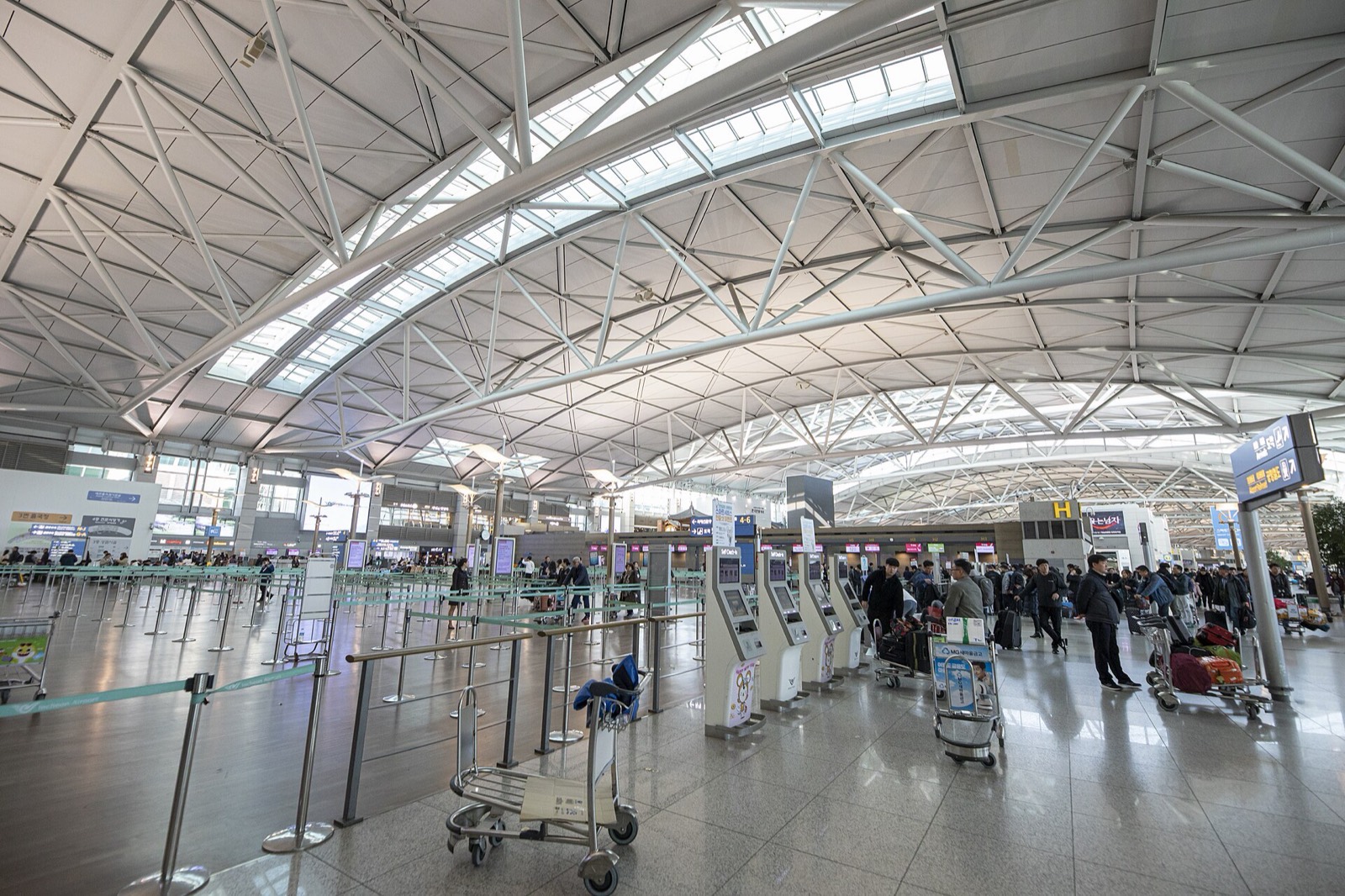
Image: Incheon International Airport Terminal 1 Departure
by Arne Müseler / arne-mueseler.com (CC BY-SA 3.0).
